Fayl:Optical flat interference.svg
Navigatsiya qismiga oʻtish
Qidirish qismiga oʻtish

Size of this PNG preview of this SVG file: 715 × 599 piksel. Boshqa oʻlchamlari: 573 × 480 piksel | 2 443 × 2 048 piksel | 1 417 × 1 188 piksel.
Asl fayl (SVG fayl, asl oʻlchamlari 1 417 × 1 188 piksel, fayl hajmi: 48 KB)
Qisqa izoh
| Taʼrif |
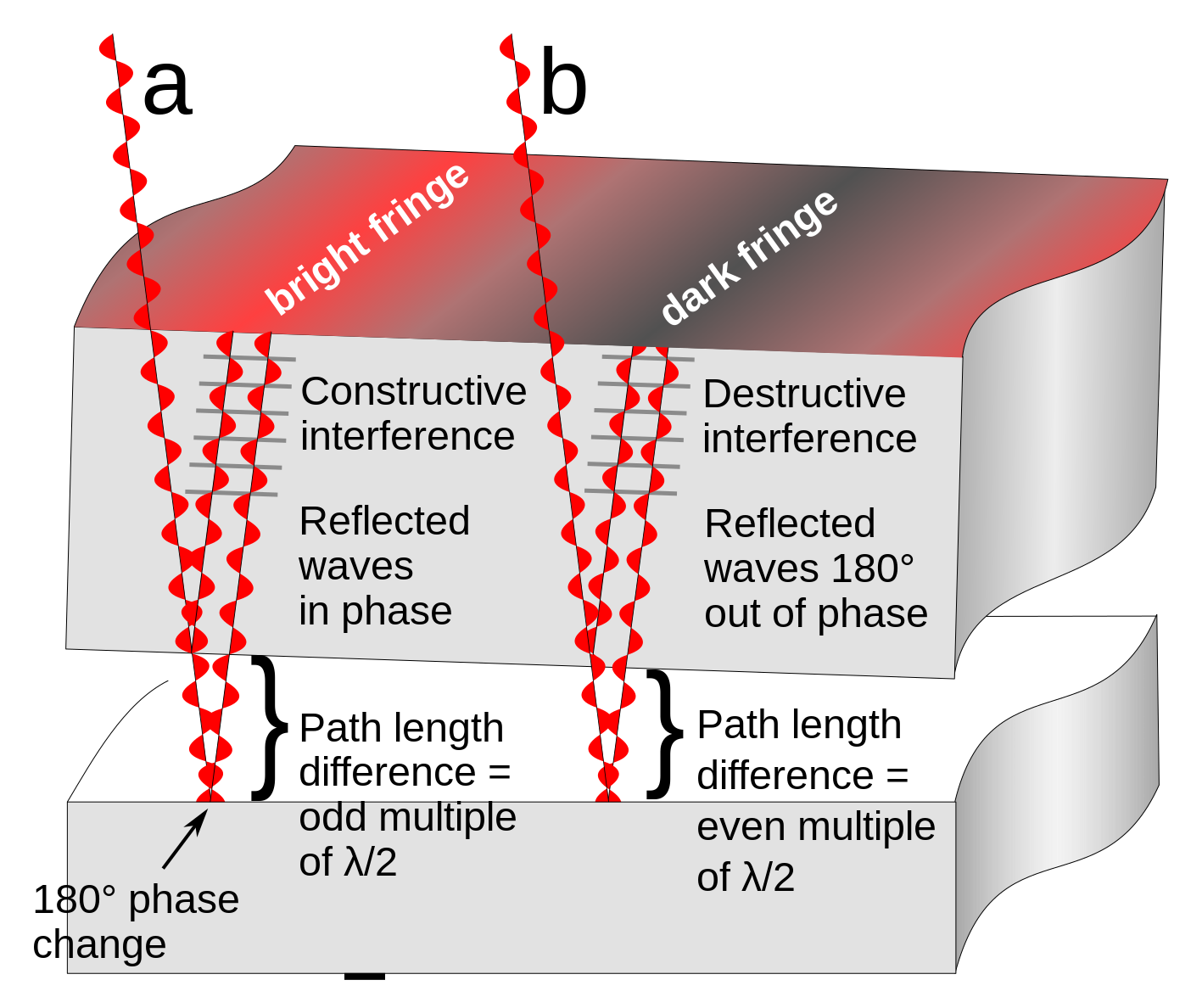
English: Diagram showing how interference fringes are created by an optical flat. The upper object is a section of a glass optical flat resting on another flat reflective surface. Light rays (red) from a monochromatic light source pass through the flat and reflect from both the bottom surface of the glass and the surface it is resting on. Since there is a tiny gap between the two surfaces, the ray reflecting off the bottom surface travels a greater distance than the top ray. It also experiences a 180° phase change at the reflection from the bottom plate (the reflection from the top plate causes no phase change). The parallel rays superpose. At locations (a) where the extra distance travelled by the 2nd ray (twice the width of the gap) is equal to an even multiple of a half-wavelength (λ/2) of the light the two reflected waves will be in phase and will add, reinforcing each other, resulting in a bright reflected ray. This is called constructive interference. At other locations (b) the path difference between the rays is equal to an odd multiple of λ/2, so the reflected waves are 180° out of phase. They subtract, canceling each other out, resulting in little or no reflected light. This is called destructive interference.
When the two surfaces are not parallel, as in the diagram, this results in a pattern of alternating bright and dark bands visible on the surface, called interference fringes. Two adjacent interference fringes represent a difference in height of the surface of one-half wavelength of the light used, so interference patterns can be used to measure the flatness of surfaces to millionths of an inch. In this diagram the width of the gap and the wavelength of the light waves is greatly exaggerated; light has wavelengths around 10-7 meter.Русский: Интерференция в тонком воздушном клине |
| Sanasi | |
| Manba | Oʻzimning ishim |
| Muallif | Chetvorno |
| Other versions |
|
| SVG genesis |  This diagram was created with Inkscape. This diagram was created with Inkscape. |




Litsenziyalash
I, the copyright holder of this work, hereby publish it under the following license:
 
|
This file is made available under the Creative Commons CC0 1.0 Universal Public Domain Dedication. |
| The person who associated a work with this deed has dedicated the work to the public domain by waiving all of their rights to the work worldwide under copyright law, including all related and neighboring rights, to the extent allowed by law. You can copy, modify, distribute and perform the work, even for commercial purposes, all without asking permission.
|
Fayl tarixi
Faylning biror paytdagi holatini koʻrish uchun tegishli sana/vaqtga bosingiz.
| Sana/Vaqt | Miniatura | Oʻlchamlari | Foydalanuvchi | Izoh | |
|---|---|---|---|---|---|
| joriy | 16:45, 2022-yil 16-yanvar | Miniatyurasi yoʻq | 1 417 × 1 188 (48 KB) | wikimediacommons>Aiden1123 | Reverted to version as of 03:54, 9 May 2017 (UTC) |
Fayllarga ishoratlar
Bu faylga quyidagi 2 sahifalar bogʻlangan:
